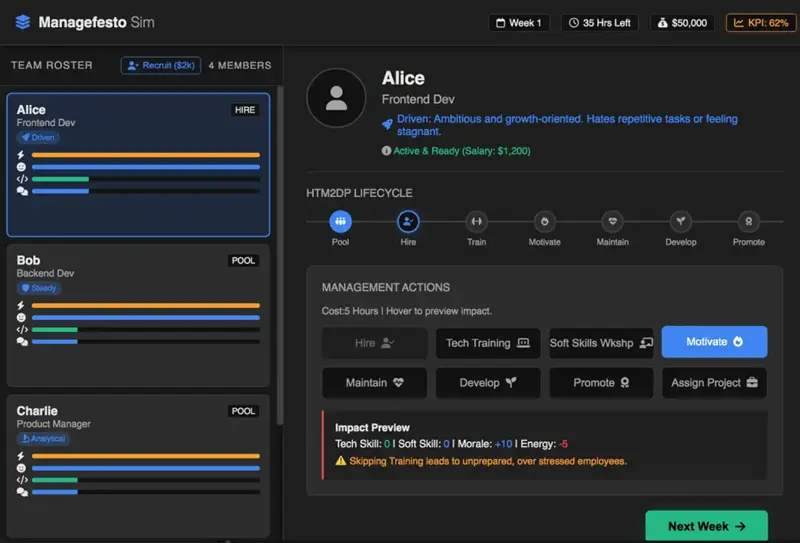
The real value of the HTM2DP MST (Management Simulation Trainer) versus the backdrop of more elaborate tools (that do not teach a methodology) and general management knowledge, is not that the MST is an exhaustive management simulation or a high fidelity "game"; it has a totally different value set. Here are the core benefits of using this tool as a way to reduce time spent in the "school of hard knocks" or "learning the hard way over time". Here are the immediate benefits of using the MST.
1. Compressing the "Management Feedback Loop" timeline
In the real 4D world (x,y,z and time = in real life), management decisions have lag times.
- Real Example: If you skip the "Maintain" phase (rest/well-being/off-time/vacation) to push for a deadline, you usually won't see the mental buildup to employee burnout for weeks to months. By then, you’ve lost the employee, and the causal link between your decisions and their departure feels ambiguous. People often never correlate why an employee just "up and quit".
- This Tool: The feedback is immediate. You skip "Maintain," the energy bar drops, and the employee enters "Burnout" status instantly.
- The Value: It trains you to get into the habit of thinking about and potentially recognizing cause and effect. While elaborate tools provide simulated analytics (charts showing what happened), there are rarely real analytics of these events. The MST provides a change to develop a specific intuition (a feeling for what will happen). It acts as a flight simulator for management, allowing a user to crash the plane 50 times in an hour without real-world consequences. HTM2DP is a methodology and the MST teaches it, quickly.
2. Visualization of "Soft" Costs
Enterprise level tools are excellent at tracking "hard" costs: salaries, hardware costs, office rent. They are notoriously bad at quantifying "soft" costs like morale, friction between personality types, or the cost of skipped the "Training" stage.
- The "Prediction Box" Feature: This is the most sophisticated part of the MST. It allows a user to hover over an action and see the calculated risk/reward based on the personality of the person the next decision will affect. This is based on psychological data tabulated and documented by thousands of sources over hundreds of years since written records have been available and Human Psychology the science has existed.
- Real World Comparison: In Jira or Asana, assigning a task shows you availability. In the MST, assigning a project shows you the probability of failure based on the employee's current energy and morale, plus the specific personality penalty (e.g., the "Analytical" type failing because of a "Soft Skills Workshop").
- The Value: It forces you to acknowledge that human capital is not fungible. The MST models the specific friction between "Driven" and "Steady" personality types which is a nuance that elaborate HRIS (Human Resources Information Systems) often treat as generic tags rather than active variables in a system. Every employee now gets assigned some sort of personality type rating and the data is hardly ever taken into consideration after the "Hire" stage. The HTM2DP MST considers this important human aspect.
3. The Value of Constraints over Complexity
Modern software suffers from "feature bloat" and low-quality code and this is one reason why your hard drive space is measured in Gigabytes and Terabytes now. We have tools for everything, yet managers often feel paralyzed by options. Give people too many choices and they will not make any.
- The HTM2DP Framework: This tool teaches HTM2DP, an at times strict, seemingly linear methodology: Hire → Train → Motivate → Maintain → Develop → Promote. The framework however is NOT overly strict nor is it linear as there is a time and place for everything and some things in moderation, as is a well known axiom. To those who are not familiar with the Management FORMULA itself, these are misconceptions about the actual nature of HTM2DP and the MST can reveal a lot of "truths" to those wishing to learn the formula, without bloat.
- The Value: By limiting the user to this specific flow, the tool teaches process discipline as well as how to leverage experience and knowledge when beneficial instead of doctrine. It prevents the common startup mistake of "hiring and immediately promoting" or "training and then ignoring." It forces the user to "pay" in Time and Budget to move to the next stage. This gamification of resource allocation teaches opportunity cost better than a spreadsheet does.
4. Technical Minimalism as a Feature
The fact that this is a platform agnostic, Operating System agnostic and instantly available online tool is a strength in specific contexts.
- Direct: It requires no login, no update, and no subscription fee.
- Transparency: Unlike a "Black Box" AI algorithm from an elaborate vendor, the logic here is visible in the source code. A manager can look at the
calculateOutcome function and understand exactly why the "Driven" employee lost morale. It builds trust in the tool because the logic is auditable. HTM2DP has nothing to hide and there is no mystery to uncover. There is no magic, there is only the truth that it actually works in real life without any trickery, guru or committee.
5. The "Fear" Factor (Risk Mitigation)
The MST includes specific, punitive mechanics for skipping steps (e.g., "Skipping Hire leads to an ad hoc, temporary workforce").
- Comparison: Elaborate tools usually allow you to do whatever you want; they are neutral platforms. If you want to assign 80 hours of work to an intern, Jira will let you.
- The Value: This tool teaches a Governance Layer. It actively discourages bad management by penalizing you (lowering KPI and even bankruptcy if your mismanagement waste enough of the companies money - triggering a "game over" scenario where you are fired!). It embeds "Best Practices" directly into the UI constraints, making bad management structurally difficult rather than just logistically possible.
The Bottom Line: Where does the HTM2DP MST fit in your toolbox?
If you are a C-suite executive managing 10,000 people, this tool is not going to give you metrics and insight. This tool can however help you to learn some things that may save your job and the company you work for (a new methodology that is designed to have positive outcomes in real life). This tool will teach you about the "thought culture" required to succeed from the ground up using "people" instead of depleting "resources".
The real value is of the MST is its ability to provide Education.
- For Junior Managers: It is a sandbox to learn that "Motivation" is not just a buzzword, but a resource bar that depletes and must be replenished.
- For HR Strategy: It is a "Minimum Viable Prototype" to test how different personality mixes (too many "Driven" people) can affect team stability and business outcomes, among other things.
The value of this tool is not in managing work or teaching routines, but in modeling the consequences of employee lifecycle management decisions. It replaces the ambiguity of human psychology with clear, predictable variables, creating a safe space to fail so you don't have to fail in real life. The HTM2DP Management Simulation Trainer is a fairly simple tool that is designed to give some insight into the Management FORMULA and how it can be used to help people succeed at work and for managers to learn a little about themselves without as much of the hard knocks part. VISIT THE FRONT PAGE OF HTM2DP.COM to grab your access to the MST, today.